Northline Seafoods Announces Completion of the “Hannah,” A State-of-the-Art Seafood Platform

Northline Seafoods Announces Completion of the “Hannah,”
A State-of-the-Art Seafood Platform

The “Hannah” Departs Bellingham for Maiden Voyage to Bristol Bay, Alaska

FOR IMMEDIATE RELEASE – Tuesday, May 28, 2024


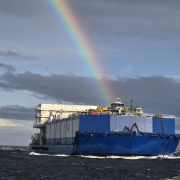
Bellingham, Wash. — Northline Seafoods proudly announces the successful completion of the “Hannah,” a state-of-the-art seafood platform that will start operating in Bristol Bay, Alaska during the 2024 salmon fishing season.

The vessel’s departure from Bellingham’s Fairhaven Shipyard on Saturday, May 25th, marks the successful completion of this more than 3-year project including 15-months of construction.

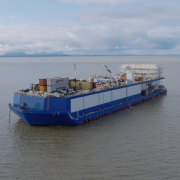
The “Hannah,” a 400′ x 100′ barge, is a vertically integrated, all-in-one solution for buying, freezing, shipping, storing, and distributing wild Alaskan salmon. This innovative supply chain platform improves quality, increases efficiency, and preserves the value of wild salmon at the source.

The vessel’s ultra-low-temperature refrigeration system creates a new production model for wild Alaskan salmon. Whole, round fish are frozen quickly to a core temperature of -30°F directly on the fishing grounds, preserving salmon in a fresh-like state.

“This is a dream come true. Seeing our vessel leave the Fairhaven Shipyard is a critical milestone for the Bristol Bay salmon industry and for Northline Seafoods. I am proud of our team and appreciative of all the people who helped us get here,” said Ben Blakey, CEO of Northline Seafoods. “Our success is shared with many partners, including the Port of Bellingham and the more than 250 local vendors who contributed to the construction of the “Hannah.” This is an important moment for us all.”

At a Glance: Northline Seafoods’ “Hannah”
• Freezing Capacity: Freezes up to 1 million pounds of salmon per day with a production crew of 20.
• Freeze Time: Freezes salmon to -30°F core temperature in under 2 hours.
• Ice Production: Produces over 1 million pounds of slurry ice per day.
• Hold Capacity (fresh): Holds 2.3 million pounds of fresh fish.
• Freezer Hold Capacity: Onboard cold storage holds over 10 million pounds of frozen salmon.
• Personnel: Total crew capacity of 95 berths, with 75 personnel for seasonal operations.
• Location: The “Hannah” will be located at Clarks Point in the Nushagak district and will buy fish from all Bristol Bay fishing districts.
• Partners: 250+ Washington-based vendors contributed to the “Hannah.”

At the end of the 2024 fishing season, the “Hannah” will return to Bellingham where it will continue to operate as a cold storage facility for the 2024 season catch. The whole, round, frozen salmon will be stored on the vessel, thawed and processed on-demand, to buyers’ specifications. In the spring of 2025, the vessel will once again make the journey to Bristol Bay, creating a cyclical, flexible, adaptable, and efficient supply chain.

In 2022, Northline Seafoods received a $40 million Food Supply Chain loan backed by the U.S. Department of Agriculture as part of the “Build Back Better” initiative.

This financing was secured through Greater Commercial Lending, a Reno, Nevada-based subsidiary of Greater Nevada Credit Union, which provides loans to businesses and organizations in underserved and rural communities. Seattle, Washington-based investment bank Zachary Scott assisted Northline Seafoods in the financing of construction and operations.

—

For more information about the “Hannah” and Northline Seafoods’ ongoing projects, please visit www.northlineseafoods.com.

Media inquiries: media@northlineseafoods.com.
—
About Northline Seafoods:
Northline Seafoods is a seafood processing company dedicated to providing high-quality, sustainably sourced seafood. With a focus on technology and transparency, Northline Seafoods is leading change through groundbreaking innovations and modernization of the supply chain of wild Alaskan salmon.

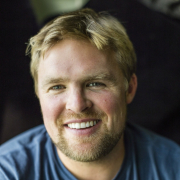
Headshot of Ben Blakey

Northline Seafoods CEO Ben Blakey floats new business model for Alaska seafood processing

Northline Seafoods CEO Ben Blakey floats new business model for Alaska seafood processing

Cliff White published in Processing & Equipment


Ben Blakey is the CEO of Sitka, Alaska, U.S.A.-based Northline Seafoods, which announced on 30 November, 2022, it is planning to build a floating salmon-processing platform to operate in Alaska’s Bristol Bay.

SeafoodSource: What is your background in the seafood industry and why did you pursue this project?

Blakey: I grew up working in Bristol Bay. My family had a processor, Snowpack Products, that operated from the early 1980s until it was sold to Icicle [Seafoods] in 2012. So basically, since I could walk, I’ve been involved in Alaska’s fishing industry. I grew up from mending nets to buying and operating fishing boats. I’ve worked in fleet management. Then I did some work in processing. My life’s work has been in Bristol Bay’s fishing industry.

SeafoodSource: How does Northine Seafoods’ new vessel, the Hannah, fit into Bristol Bay’s salmon supply chain?

Blakey: It’s a floating fish-processing platform, primarily focused on quickly freezing the fish. We won’t do any value-added processing in Bristol Bay, we will just buy fish from fishermen and take fish from tenders and then we’ll freeze them immediately in whole, round form. We’re not heading or gutting them, we’re just trying to stabilize them as quickly as possible, so that when they are thawed out that they’re in as fresh of a state as possible. What that means is we’re going to have a smaller labor footprint. We will be able to do 750,000 to a million pounds of fish a day with 23 people working on the floor. So it will be extremely efficient from a labor perspective. In addition, we won’t use standardized container transport. Currently, the vast majority of frozen salmon leaving Alaska end up in 40-foot frozen containers. We will instead just store them inside of our barge, which can carry north of 14 million pounds of frozen product. So those will be shipping costs that we don’t have to pay. Instead, we will just haul the entire barge south back to the Pacific Northwest after the salmon season, meaning the barge will act as a consolidated or integrated shipping option. We will store the fish on the vessel until we plan to have them processed or they go to market. With the barge acting effectively as a cold storage facility, that will mean there’s far less movement of the product – we won’t have to transport it on trucks through ports, forklift them around or tuck them into cold storage.

SeafoodSource: Are you going to be contracting with tenders or local fishermen?

Blakey: No, we will have our own dedicated fleet. And we will hire and utilize our own tenders to help serve the fleet and provide buying access.

SeafoodSource: With the uptick in fish being caught in Bristol Bay in recent years, is this additional storage and processing capacity necessary there?

Blakey: There is a need for it. Last year was an extremely large run, which saw an excess of capacity and an excess of what existing processors could freeze. But aside from the run size, there were issues with other parts of the supply chain, including a shortage of containers, and there’s been a shortage of cold storage nationwide, and trucking fees have gone up substantially since the start of the [Covid-19] pandemic.

Beyond there being a need for it, we are simplifying and making the supply chain more efficient. One major part of that will be our use of integrated ultra-low temperature facilities, freezing and story all of our products at negative 25 degrees Fahrenheit, which allows it to be extremely fresh when it’s thawed out and reprocessed in the lower 48 [U.S. states]

SeafoodSource: What types of products will you be buying, and where will you selling your products?

Blakey: We plan to buy all species in Bristol Bay and, you get a little bit of every species. The vast majority will be sockeye. We will be selling to other distributors who serve retail markets. We do work with some sashimi-grade sushi buyers up in British Columbia that serve the greater Vancouver, [Canada] area, and we have foreign buyers too, including in Thailand and the Philippines, but a large portion will end up in the fresh case in the U.S.

SeafoodSource: So secondary processing will take place on land in the lower U.S.?

Blakey: Yes. Once the vessel returns to Washington [after the season], we will perform some of the value-added steps ourselves on board, but things like heading and gutting, filleting, and other value-added steps that get the product closer to the consumer will be completed by existing reprocessors that we contract with, primarily in Seattle, and other parts of the Pacific Northwest – such as IPC and Quality Foods in Bellingham, Washington.

Our plan is to keep the pace of reprocessing more controlled, completing it throughout the course of the year, aiming for 50,000 pounds a day instead of trying to fillet a million pounds a day. That way, it’s far easier to control our costs and our timing and improve our yields, so we end up with a higher percentage of usable product that’s better-created and easier to meet the specs the customer has asked for.

SeafoodSource: Where did you get the idea of the Hannah from?

Blakey: The idea actually originated from our chief technical officer, Drew Cohen. When we lost our previous barge [in 2020] after it wrecked on the beach in a storm, we sat down and started kicking around ideas and how we could improve what we operated before. And that’s what led us to this current design.

SeafoodSource: Do you think this type of hybrid vessel is the future for Alaska’s salmon industry?

Blakey: I certainly think it has a strong place in the future of Alaska’s salmon fisheries and salmon fisheries worldwide. Floaters are expensive, but one of the ways that we were able to make this more economical is it’s designed to operate at anchor so it doesn’t operate under way, which kind of lowers the regulatory thresholds that we have to meet.

The idea is to cut a lot of costs and make it far more efficient to operate than the existing supply chain coming out of Alaska. But I don’t necessarily think it would apply to all fisheries. This design is probably less applicable for pollock or groundfish in the Bering Sea, but there’s a herring fishery out of Togiac that takes place in the spring, and we’re looking at participating in that fishery and any other fisheries we could work in between mid-August and the start of our big season for refreshed sales, which doesn’t really kick off until October.

SeafoodSource: Can your business model survive any type of cycle of salmon runs, or is it based off of the bigger runs Bristol Bay has experienced lately?

Blakey: We fully designed the business model to accommodate variable runs, and with smaller runs, it actually operates better. Economically, it’s more-efficient compared to kind of traditional platforms or traditional processing in years of lower volume, and that’s primarily because our overhead is lower, and our sunk capital costs going into the season are far lower. Instead of having a few hundred people onboard that require managers and maintenance and mechanics for the various value-added lines, we don’t have any of that. And by consolidating our shipping and cold storage, we’re cutting costs, so it actually makes us a more-efficient platform.

SeafoodSource: How have you funded the project? Who are your investors? Are you still raising money?

Blakey: Thankfully we’re done with fundraising and I can safely say we do not need more money. We spent about two years in the foxhole, designing, fundraising, and working hard to get to this step. We have a number of investors but I’m not currently prepared to disclose their names. With time and with their decision to go public, I would like to speak more about them. But again, it’s up to them. I can say they’re all U.S.-based investors, because the Jones Act requires fishery endorsed vessels to be owned by U.S. citizens.

We’re just excited to get started moving through the construction process and into operations. We’ve got a great team of dedicated people who had to fight tooth and nail to get us here. We have this great opportunity to build something innovative and new, and we want the fleet to know that we’re coming back and buyers to know the platform will be operational in 2024.We’re very excited to move forward and I think we’ve got the right people on board to get it done.

Photo courtesy of Northline Seafoods

Read more.

Mobile salmon-processing platform planned to bring fish from Alaska to Bellingham Bay

Mobile salmon-processing platform planned to bring fish from Alaska to Bellingham Bay

By Rachel Showalter Updated December 02, 2022 9:38 AM


Northline Seafoods, a company that processes Bristol Bay Alaskan Salmon, is commissioning a mobile, commercial salmon processing platform to be built in Bellingham starting in January 2023. “We’re building a vessel that we hope is going to revolutionize how fish are processed and brought to market out of Alaska,” said Co-founder and CEO of Northline Seafoods Ben Blakey in a telephone interview with The Bellingham Herald.

Once it’s complete, the 400-foot by 100-foot vessel — known as the Hannah — will go to Bristol Bay, Alaska, every summer to buy salmon directly from fishermen. The salmon will be immediately frozen on the Hannah and transported back to Bellingham Bay where they will be stored, reprocessed and distributed all year long from the same vessel. “The existing path from Alaska to getting (the salmon to Bellingham) is a long and complex supply chain,” Blakey said. “What the Hannah aims to do is consolidate a lot of the steps of fish changing hands between the processors, shippers and cold storage folks and integrate it into a single system.” The vessel can hold up to 14 million pounds of salmon, according to Blakey. “This is the first of its kind,” Blakey said. “We thought it would be a great idea to take some of those steps into our own hands and improve quality.”

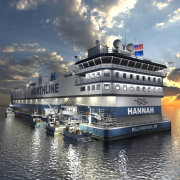
A rendering shows what the Hannah mobile salmon processing platform will look like once construction of the vessel is complete in 2024 in Bellingham. Drew Cohen, Northline Seafoods Courtesy to The Bellingham Herald The Hannah will provide a “net-benefit” to other local Bellingham fishing companies, according to Blakey, by providing them with more raw fish. Northline Seafoods will still rely on existing seafood companies to complete the final step in preparing the salmon for distribution, Blakey told The Herald. When construction is complete, the vessel is expected to create 37 full-time jobs year-round for people based in the Bellingham area. Those positions include engineers, refrigeration specialists, logistics specialists and sales and distribution managers.

“Over 6,000 jobs in Whatcom County are created or supported by marine trades and the Port is thrilled to see more jobs coming to our dynamic working waterfront,” Port of Bellingham spokesperson Mike Hogan wrote in an email to The Herald. The Hannah will have a number of environmental benefits as well, according to Blakey. The vessel is expected to use less diesel, cut traffic and transportation emissions and reduce fish waste compared to typical fish processing and transportation methods. The construction itself is expected to take about 15 months and generate about $12 million in construction wages and new full-time jobs for Whatcom County, Blakey told The Herald.

The Bellingham Herald was unable to independently confirm the builder for the project. The ‘Hannah’ is expected to be operational for the 2024 summer salmon season, according to Blakey. Northline Seafoods secured a $40 million USDA food supply chain loan to be used to partially fund the construction of the vessel, according to Blakey. He declined to state to exact cost of the construction project.

This story was originally published December 2, 2022, 8:20 AM.

Read more.

Northline Seafoods New Freezer Barge “Hannah” is Game Changer in Bristol Bay

Mobile salmon-processing platform planned to bring fish from Alaska to Bellingham Bay

By Seafood News Updated December 01, 2022


Sitka, AK-based Northline Seafood announced yesterday that it has secured $62.5 million in funding to build an innovative platform that will buy, freeze, ship, store and distribute Bristol Bay sockeye salmon. The “Hannah” is scheduled to arrive in Bristol Bay in the spring of 2024.

Part of the $62.5 million is a $40 million loan put together by Greater Commercial Lending (GCL) and guaranteed by the U.S. Department of Agriculture through the Food Supply Chain Guaranteed Loan Program, part of President Biden’s “Build Back

Read more.

A Sitka processor lost everything in 2020. Now it’s planning a comeback with a bigger boat and a better idea

A Sitka processor lost everything in 2020. Now it’s planning a comeback with a bigger boat and a better idea

Posted by Robert Woolsey, KCAW | Nov 30, 2022


The wreck of its processing barge in Bristol Bay two years ago could have been the end of the newly-formed Northline Seafoods, but the Sitka-based operation is planning a comeback – in a big way.

On Wednesday (11-30-22) Northline announced it had received a $40 million dollar food supply chain loan to not only rebuild its floating processor, but also to reinvent the industry in the Bay.

The pictures from the wreck of Northline’s SM-3 processing barge are not pretty. The 150-foot vessel began service in Southeast Alaska as a platform for helicopter logging, with an upper deck originally designed for aircraft.

That superstructure collapsed when the SM-3’s anchor buoy parted in a September gale in 2020, and 80 mile-per-hour winds blew it ashore in Bristol Bay not far from Ekuk.

The six crew aboard escaped unharmed, but the $7-million dollar barge was a crumpled pile of twisted metal – and in the hands of salvagers and insurance agents.

No one was injured when Northline’s previous processing barge, the SN-3, was wrecked in the first autumn gale of the season in 2020. But the $7 million project was a loss. (Photo provided by Russell Nelson)

Northline CEO Ben Blakey says the loss of the SM-3 was also a turning point, and a chance to rethink the company’s model, which is to have a floating processor available closer to the fleet, and spare them the long run from the fishing grounds to shore-based processors in Naknek. The SM-3 was innovative, but it wasn’t perfect.

“We had to ship using the traditional methods of freeze containers that increases cost – it’s very inefficient,” Blakey said. “And  there’s there’s snags and snarls along the path from Alaska to Seattle. So this new barge will actually integrate the freezing process: buying fish from fishermen, freezing them, we’ll store them on board, and then tow the entire vessel to the Pacific Northwest, in the winter months where they’ll be distributed. So it’s kind of a way to cut out cold storage, cut out shipping, and take it all in-house and consolidate it.”


With $40 million now in hand from a US Department of Agriculture Food Supply Chain loan, plus another $22 million in financing from a company called Greater Commercial Lending and a Seattle investment banking firm Zachary Scott, Northline is literally doing what President Biden’s infrastructure bill suggests, and “Building Back Better” – or at least, bigger. The new processor, the “Hannah,” will be three times larger than the SM-3. But like its predecessor, the Hannah will also be a repurposed vessel. In this case, a massive container barge.

“It had been shipping containers between I believe Florida and the US Virgin Islands,” said Blakey. “So it’s older, it was built in the late 90s. But it has a lot of life left. And it’s large – it’s 400 feet long by 100 feet wide, which is substantially larger than the last barge that we rebuilt.”

Read more details about Northline’s plans here.

Blakey says that even before the SM-3 was wrecked, Northline was looking for ways to improve its model of flash-freezing fish in the round, and shipping them directly to markets for processing. Initially, the idea was to build another barge for storage and shipping, to tie alongside the SM-3. After the accident, Blakey credits the company’s chief technical officer, Drew Cohen, for coming up with the all-in-one concept behind the Hannah. Northline believes that doing more with less is a winning formula for the industry.

“It’s certainly a question of efficiency,” he said. “So the original platform was designed to operate with a smaller labor footprint, which we did. So we were able to freeze 200,000 pounds a day with a fraction (of the labor) of what you would typically use to freeze 200,000 pounds a day of headed and gutted fish. So we’re incorporating that. But then in addition, this platform is different. Since we’re adding in the shipping component and the storage component, we’re expanding our savings, and hoping to use those savings to both improve the market and quality but also pay fishermen a better price.”

The Hannah is being towed from the Gulf of Mexico to Bellingham, and construction will begin in January. The vessel will house about 75 processors and engineers, but most of its volume – 80-percent – will be cold storage. Once on the grounds, the Hannah will hold 14 million pounds of Bristol Bay sockeye: An awesome tribute for… whoever the real Hannah is.

“It’s not the name of my wife or anyone else’s wife that I’m aware of,” said Blakey. “But its name is important to one of our investors. And also, as I understand it, it was the name of the first ship in the US Navy, commissioned in the late 1700s.”

Although the Hannah will be built in Bellingham, Blakey says that Northline’s offices and “brain trust” will remain in Sitka. The company plans to have the barge ready to enter service for the 2024 fishing season.

Read more.